Understanding PFAS
Every day, Tyler Water Utilities laboratory staff tests the City's water before, during, and after the water treatment process to make sure Tyler tap water meets all safety and health guidelines. The U.S. Environmental Protection Agency (EPA) sets these guidelines as part of its authority under the federal Safe Drinking Water Act. The Texas Commission on Environmental Quality (TCEQ) enforces these guidelines in Texas.
Recently a category of chemicals known as PFAS or "forever chemicals" has been in the news. See the information below to help you understand this issue.
What are PFAS chemicals?
Per- and poly-fluoroalkyl substances, also known as PFAS chemicals, have been used since the 1940s in industry and consumer products like nonstick cookware and firefighting foam, according to the EPA.
PFAS can get in the environment and have been found in soil, water and air. They can stay in the body for a long time and may cause health problems.
Common uses of PFAS chemicals have included the following, according to the Department of Energy:
- Water resistant clothing
- Building and construction
- Paint
- Mechanical components
- Firefighting foam
- Non-stick cookware
- Pesticides
- Cosmetics
- Stain resistant products
PFAS Public Presentation
Are PFAS chemicals monitored in drinking water?
The EPA determines what community water providers in the U.S. test for and report to the public. These guidelines are called the National Primary Drinking Water Standards. The Standards evolve over time as rigorous scientific examinations reveal new concerns.
In March 2023, the EPA released a proposal for the first National Primary Drinking Water Standards for the six PFAS chemicals listed below. One part per trillion equals 1 drop of water in an Olympic-size pool. On April 10, 2024, the EPA announced the final National Primary Drinking Water Regulation for six PFAS chemicals.
The list below shows the EPA's Maximum Contaminant Level (MCL) and the Maximum Contaminant Level Goal (MCLG) for five of the substances in parts per trillion (ppt), as well as the Hazard Index proposed for a mixture of four PFAS chemicals. An MCLG is the level of a contaminant in drinking water below which there is no known or expected risk to health. An MCL is the highest level of a contaminant that is allowed in drinking water. MCLs are set as close to the MCLGs as feasible using the best available treatment technology.
A Hazard Index is made up of a sum of fractions. Each fraction compares the level of each PFAS measured in the water to the highest level determined not to have a risk of health effects.
Drinking Water Standards for Six PFAS Chemicals
- Perfluorooctanoic acid (PFOA)
MCLG 0 ppt | MCL 4.0 ppt
- Perfluorooctanesulfonic acid (PFOS)
MCLG 0 ppt | MCL 4.0 ppt
- Perfluorohexanesulfonic acid (PFHxS)
MCLG 10 ppt | MCL 10 ppt
- Perfluorononanoic acid (PFNA)
MCLG 10 ppt | MCL 10 ppt
- Hexafluoropropylene oxide dimer acid (HFPO-DA (GenX))
MCLG 10 ppt | MCL 10 ppt
Hazard Index of 1.0 - Perfluorohexanesulfonic acid (PFHxS), Perfluorononanoic acid (PFNA), Perfluorobutanesulfonic acid (PFBS) and its related compound potassium-PFBS, Hexafluoropropylene dimer acid (HFPO-DA) and its ammonium salt.
What do Tyler tests show?
The federal Safe Drinking Water Act (SDWA) requires that once every five years the EPA issue a list of unregulated contaminants to be monitored by public water systems (PWSs). The latest round of required testing, known as the fifth Unregulated Contaminant Monitoring Rule (UCMR 5), requires sample collection for 29 PFAS chemicals, including those in the proposed EPA guidelines, and Lithium.
These tests are being conducted from 2023 to 2025.
UCMR 5 will be unique from previous tests for PFAS chemicals because detection levels possible with newer analytical methods are so much lower than in the past, at about 5 parts per trillion for most PFAS on the list. Testing schedules for cities are set by the EPA and staggered throughout three years. Each community is required to test water that is leaving their treatment plants four times during a 12-month period.
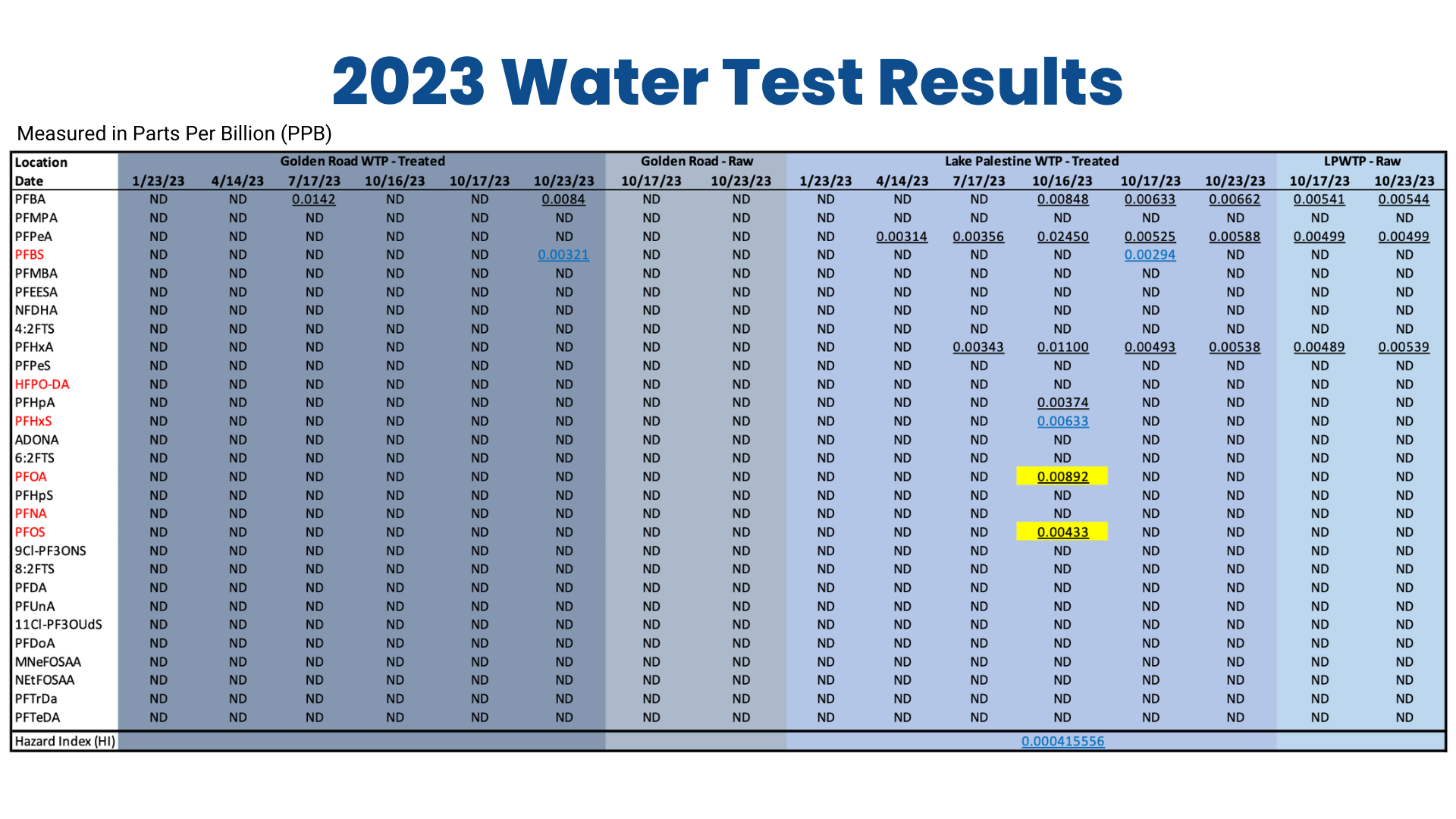
Test Results
We tested for 29 different compounds in each quarter of 2023. Most of the 29 PFAS were not detected in the samples taken both at the raw and treated water. We analyzed a total of 464 samples with only 25 detections.
The EPA at this time has chosen six particular compounds that will be regulated in the future.
Review the PFAS Presentation to learn more about the EPAs regulation and how to interpret the data.
What is planned for the future?
The most efficient and effective removal methods are still being evaluated by federal regulators, safety researchers, and the water industry. While we work on pilot programs to improve the taste and smell of our water, we will also be evaluating filtering options for these emerging PFAS.
We will continue testing for the 29 chemicals in the UCMR5 and make results available to the public. Tyler Water is monitoring developments at the national level so that it can plan for future costs that may be associated with new regulations.
To learn more about PFAS chemicals, please visit the websites below: